

Client
JIMJIM
MY ROLE
JIMJIM
DESIGNING AN APP that gives adult children a calm, honest read on their aging loved one's health.

Families do not need more raw health data. They need confidence.
Adult children often become informal care coordinators overnight. They are expected to manage safety, health changes, appointments, siblings, and emotional stress. All without a clear signal for when something is actually wrong.
THe core product problem
The Problem
Most wearables are designed for self-optimization. JimJim needed to be designed for shared caregiving: low-friction for the parent, actionable for the family, and calm enough not to create alert fatigue.
Signal overload
Families do not know which changes matter.
Delayed awareness
Small changes are often missed until a crisis.
Adoption friction
Older adults reject devices that feel clinical or stigmatizing

“I don’t want to monitor every number. I just want to know if my mom is okay, and what I should do next.”

THE CORE CONSIDERATIONS
Balancing displaying the right amount of data to be useful rather than overwhelming
Ensuring trust and privacy throughout the app
Legibility for older audiences
Easily digestible and genuinely useful data displays and insights

Product Process
From ambiguous idea to testable product system.
I treated JimJim as a full product discovery challenge: define the user problem, validate the emotional stakes, translate health signals into family-friendly language, and design a system that could scale from MVP to deeper preventative insights.
Discovery
Interviewed caregivers to understand anxiety, daily coordination, trust, and what “peace of mind” actually means.
Hypothesis
Reframed the product from “show vital signs” to “surface meaningful changes and suggested next steps.”
System Design
Mapped wearable data, family roles, alert thresholds, notes, tasks, appointments, and weekly summaries.
Prototype
Designed a functional mobile app prototype to validate onboarding, dashboards, alerts, and family sharing.
Data Architecture
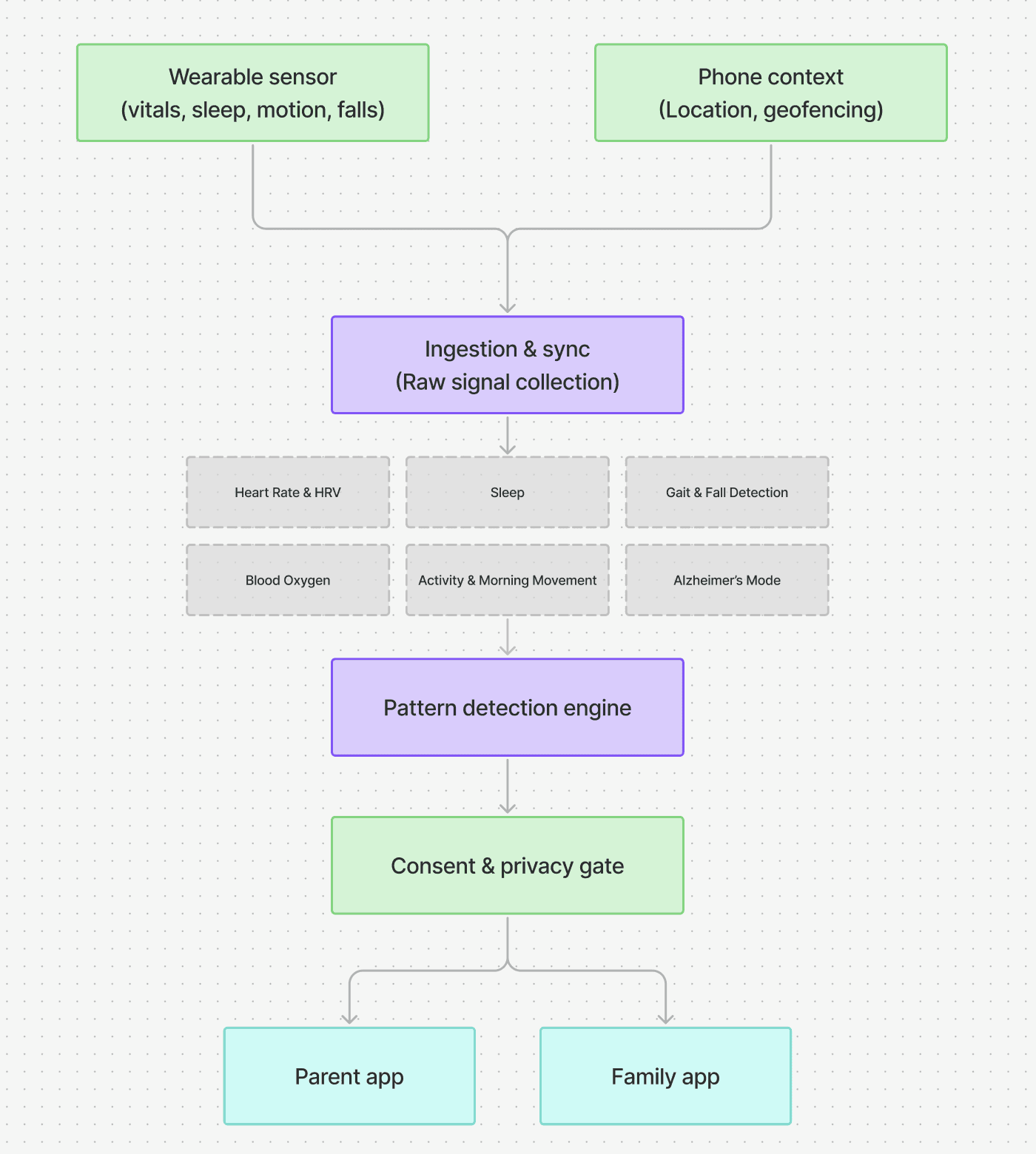
Before any screen was drawn, I wrote a full spec for every signal JimJim would track and, just as important, how each one would be allowed to surface. Complex data only earns a place in the interface if it changes what someone does next.
Research & Personas
Every JimJim household has 2 users with opposite needs, often in outright tension with each other. Getting both personas right, not just designing for "the caregiver", shaped almost every decision that followed.

Primary User
The Adult Child
Wants reassurance more than raw data. Checks in on a busy schedule, often managing this alongside siblings who disagree about how involved to be. Needs a fast, honest read, not a dashboard to interpret.

secondary User
The Parent
Values independence above almost everything. Will reject or stop wearing anything that feels like surveillance. Needs to feel cared for, not monitored. The design has to earn continued consent, not just initial opt-in.
Key Screens
A calmer way to understand health changes.
The product experience prioritizes trend interpretation over metric dumping. Instead of forcing families to interpret heart rate, sleep, SpO₂, activity, and temperature in isolation, JimJim synthesizes changes into a daily wellness picture.
design decision 01
Designed for trust before depth
Early versions exposed too many data points. I simplified the hierarchy so the first read answers “Is anything changing?” before exposing deeper metric detail.
design decision 02
Positioned alerts as guidance
Alerts were written to reduce panic. Each one includes context, possible reasons, and a suggested next action.
design decision 03
Made the wearable emotionally acceptable
The long-term hardware direction is jewelry-like and easy to wear, avoiding the stigma of medical devices.


Website Design & Dev
I designed and developed JimJim's marketing website (through Figma and Framer)
Result
6 months ago, JimJim was just an idea. Now, it's a fully-functioning app that is helping families to notice the warning signs before emergencies happen.
0
0
Founding Families
Are currently helping JimJim in the beta program.
0
0
Households
JimJim is currently being used in about 1000 households across America